Menu
How Tfh cells shape antibody immunity in people.
We study human T follicular helper cells and the germinal centers they organize, across vaccination, infection and transplantation. Our work follows four connected themes.
Germinal centers and inflammatory signaling
How the inflammation present at the start of an immune response shapes the Tfh–B cell partnership and the memory it leaves behind.
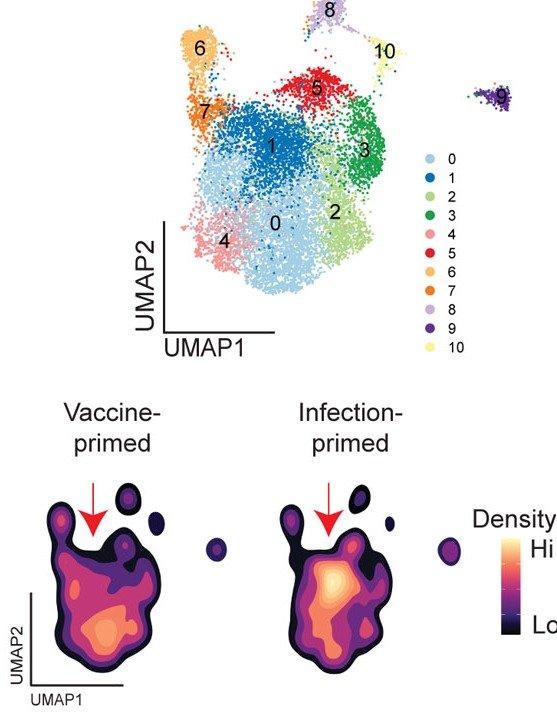
Tfh cells guide B cells through selection in the germinal center, which determines the quality and durability of antibody responses. The inflammatory signals around a response, from infection or from aging, can change how this process unfolds for months or years afterward.
We showed that SARS-CoV-2 infection leaves an interferon-linked imprint on memory CD4 T cells that persists through later vaccination. We now ask how acute and age-associated inflammation alters Tfh differentiation and germinal center output, including in people living with long COVID.
Tfh contributions to xenograft rejection
What human T cells do when they encounter a pig organ, and how Tfh help could drive the antibodies that reject it.
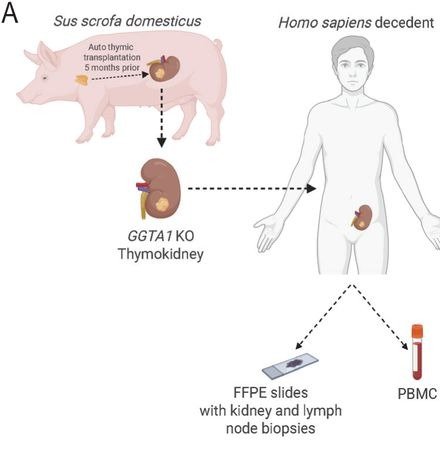
Pig-to-human transplantation could ease the organ shortage, but antibody-mediated rejection remains a central barrier, and those antibodies depend on help from Tfh cells in germinal centers.
As part of NYU Langone’s pig-to-human decedent xenotransplant program, we follow human T cells after kidney xenotransplantation: which clones recognize pig antigens, whether they differentiate into Tfh and drive germinal center and anti-pig antibody responses, and how immunosuppression changes these responses. We also work to define what xenoreactive T cell receptors recognize.
Cellular predictors of vaccine responses
Reading early cellular signals to know who a vaccine will protect, and why it fails for others.
Vaccines do not work equally well for everyone. Responses are weaker in older adults, in people receiving immunotherapy or immunosuppression, and in a subset of otherwise healthy adults. We use vaccination as a controlled immune challenge in people, sampling blood and draining lymph nodes to find the cellular features that separate durable responses from poor ones.
Our hepatitis B vaccine studies link poor responses to Tfh dysfunction in the lymph node. Related work spans influenza, mpox and SARS-CoV-2 vaccines, building on our earlier finding that circulating Tfh are early, sensitive readouts of vaccine responses.
Algorithm development for spatial immunology
Open-source tools for measuring how immune cells organize inside human tissue, and whether that organization predicts outcomes.
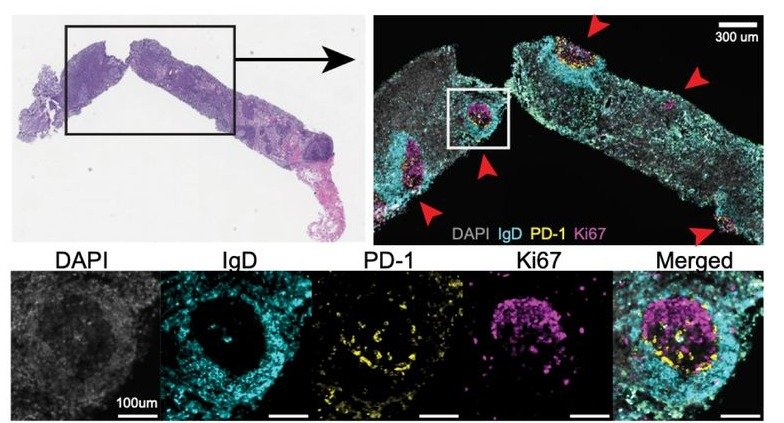
Multiplex imaging and spatial transcriptomics now record where every cell sits in a lymph node. Turning those maps into biology requires statistics built for human samples, where differences between people are large and each tissue is its own experiment. We develop R packages that test cell–cell organization across patients rather than within a single image.
ESImap (Effect Size Interaction mapping) scores whether two cell types sit next to each other more often than chance in each sample, then compares groups with effect sizes across biological replicates. Using it, we found that contacts between activated Tregs and exhausted CD8 T cells in melanoma sentinel lymph nodes are associated with later recurrence. RippleR, developed by Yee Hoon Foong, analyzes Xenium and Giotto data in concentric rings around tumor regions to follow how cell composition and gene expression change with distance.